
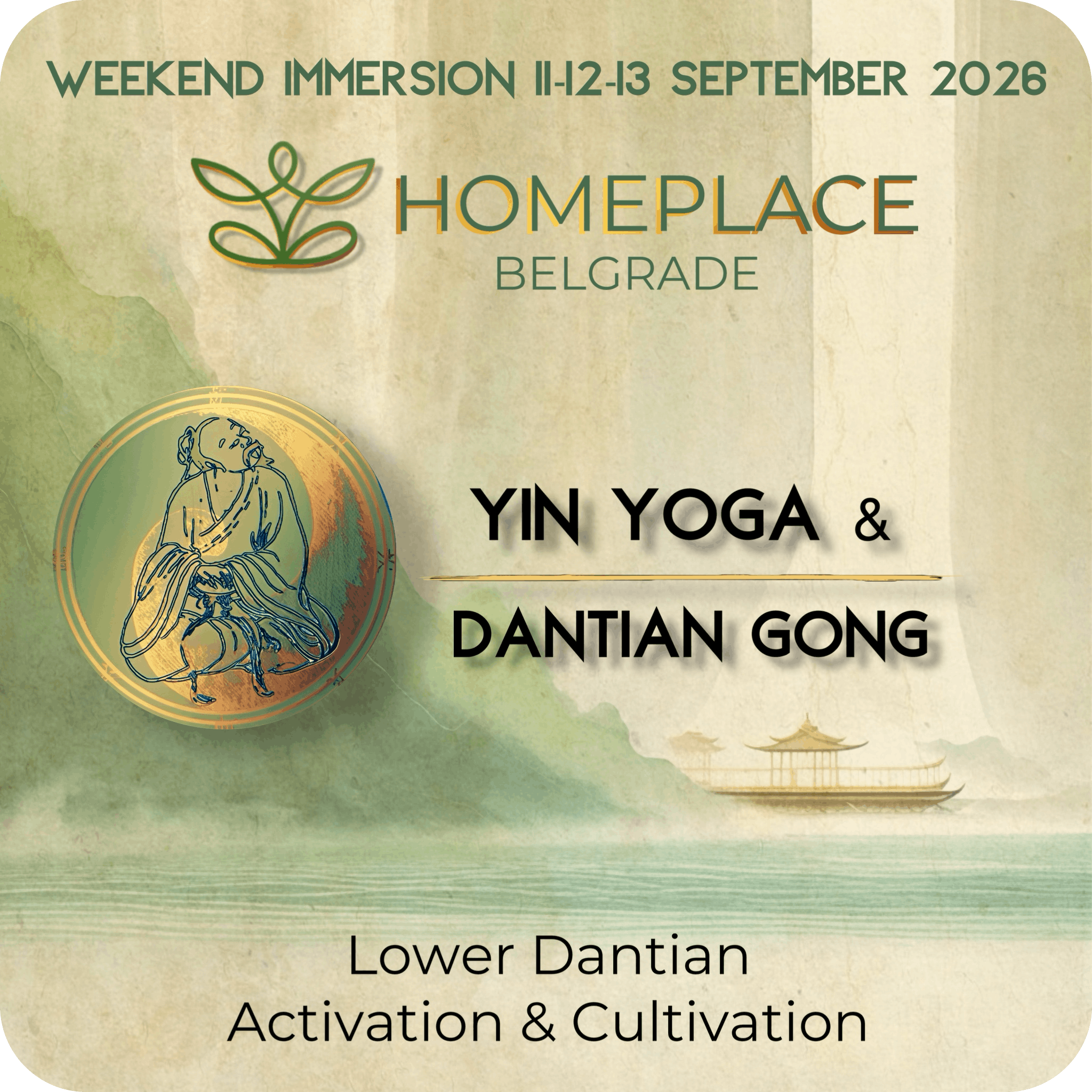
CONNECTION & CULTIVATION OF THE LOWER DANTIAN.
Yin Yoga Immersion Weekend - Practice & Theory - Language: English 🇬🇧
The lower abdominal region (below the navel), known as the Lower Dantian (xia dantian 下丹田), acts as the body’s energetic root and serves as the source from which this process—as the center of gravity and reservoir of prenatal Qi—nourishes the Middle (Heart) and Upper (Mind) Dantians.
It is from this region of the body that all the energy animating it originates. It is surrounded by various muscle groups and connective tissues. This complex network of tissues is connected to most of the body’s myofascial lines. The more the nerve pathways that establish this connection develop, the more apparent the relationship with this space becomes. In the internal arts, the lower Dantian refers to the source of Qi (氣)— the area from which it emanates, to which it returns, and where it accumulates and transforms. Its activation or reconsolidation restores its original density, which is cultivated through breathing, stillness, and focused attention—characteristics of the internal arts. This process of involution is often called “the return to the source.”
To learn more about the Lower Dantian, click the link below to read our article.

WEEKEND IMMERSION PROGRAMME
Friday 11 September
17.00 - 19.00 - PRACTICE
Preparation for the Lower Dantian practice: Yin Yoga & Following the Ox
This preliminary meditation practice has two objectives: first, to define the boundaries of the lower Dantian, and second, to calm the mind. By slowing down all bodily rhythms, the practitioner will find the calm necessary to refocus on the Lower Dantian.
This two-hour class includes a Yin Yoga sequence for the main bony structures and joints surrounding the spine and hips, as well as a meditation called “Following the Ox.”
Saturday 12 September
9.00 - 12.00 - PRACTICE
Warm-up Routine: Patting the Eight Hollows (Pai Ba Xu 拍八虚)
Pai Ba Xu is a specific tapping/self-massage technique that is highly effective at clearing stagnant Qi from the body.
Tao of Yoga
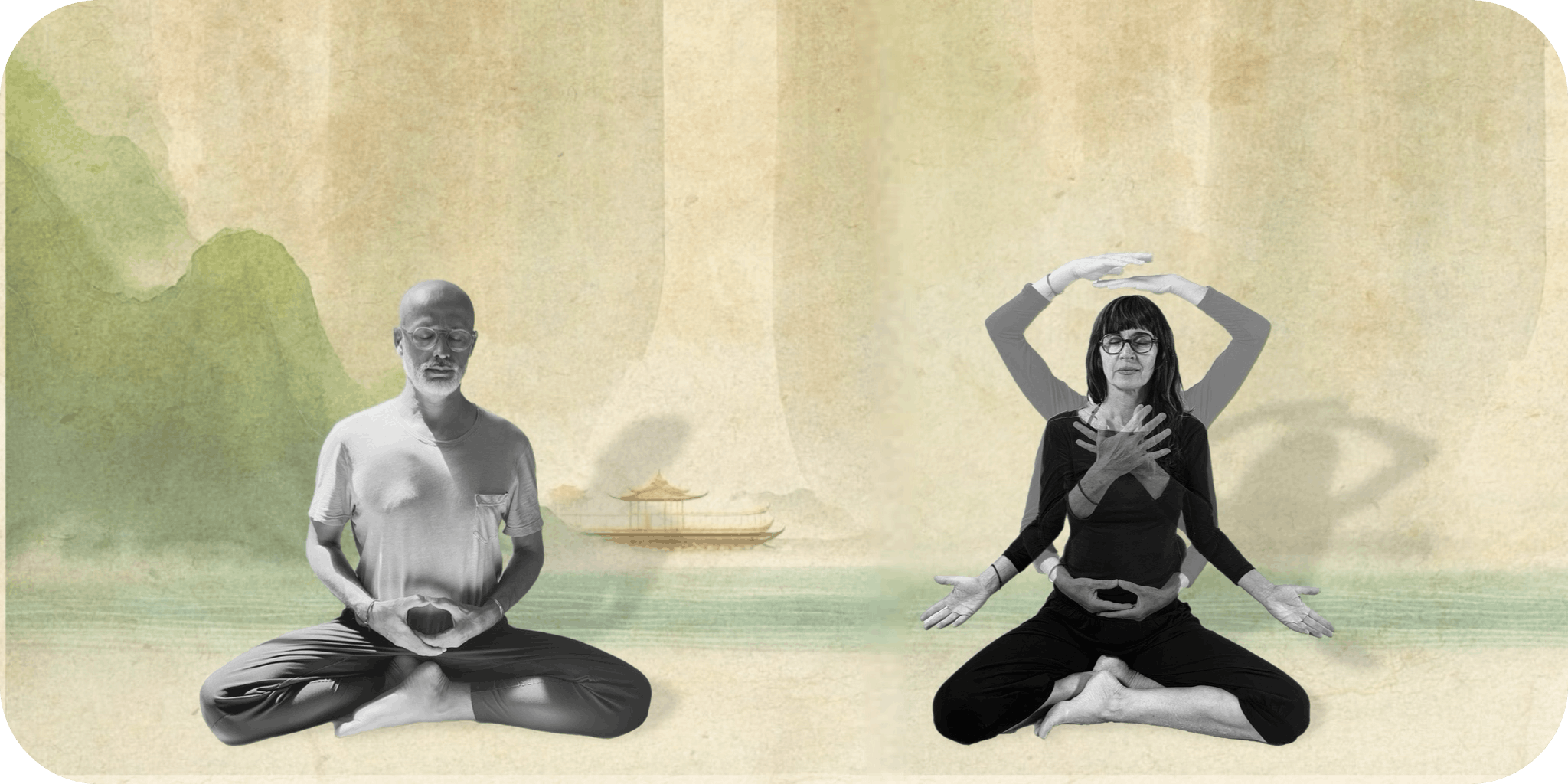
This postural practice is a harmonious blend of Yin Yoga and Taoist movements, such as Ji-ben Gong and Song Gong. This combination of exercises targets the body’s main myofascial lines, contributing to the connection and release of the entire connective tissue network.
10 Minutes Break
Reverse Breathing - Meditation
This breathing practice lies at the heart of cultivating the lower Dantian. In many internal arts traditions, the main aims of reverse breathing are to develop control over the breath and bodily mechanics to gather and circulate Qi more consciously. It strengthens the lower abdomen and coordinates the abdominal magnetic field as well as the subtle internal movements during inhalation and exhalation.
14.00 - 14.50 - THEORY
Lower Dantian - Anatomy to Energetic
An introduction to the Lower Dantian and the various physiological and anatomical correspondences within the body, and its function as a storehouse of primordial energy (Jing or essence).
10 Minutes Break
14.50 - 17.00 - PRACTICE
Fundamental principles of Qi Gong
A Qi Gong Session to open up the spine and connect with the centre of gravity - Lower Dantian.
Yin Yoga & Meditation
A Yin Yoga sequence and reverse breathing meditation.
Sunday 13 September
9.00 - 12.00 - PRACTICE
Warm-up Routine: Patting the Eight Hollows (Pai Ba Xu 拍八虚)
Pai Ba Xu is a specific tapping/self-massage technique that is highly effective at clearing stagnant Qi from the body.
Tao of Yoga
This postural practice is a harmonious blend of Yin Yoga and Taoist movements, such as Ji-ben Gong and Song Gong. This combination of exercises targets the body’s main myofascial lines, contributing to the connection and release of the entire connective tissue network.
10 Minutes Break
Following the Ox - Meditation
This preliminary meditation practice has two objectives: first, to define the boundaries of the lower Dantian, and second, to calm the mind. By slowing down all bodily rhythms, the practitioner will find the calm necessary to refocus on the Lower Dantian.
14.00 - 14.50 - THEORY
Understanding and Applying Ting and Song
Ting - attentiveness (聽) refers to ‘the energy of listening’. This practice encourages calmness and receptivity, key elements of Taoist meditation, allowing practitioners to attune themselves to the subtle flow of qi and natural rhythms.
Song - Often translated as ‘relaxation’ or ‘loosening’ (鬆), is a fundamental principle which refers to a state of effortless relaxation/release. Song is the relaxed, receptive state; Ting is the listening that becomes possible because of that state.
10 Minutes Break
14.50 - 17.00 - PRACTICE
Fundamental principles of Qi Gong
A Qi Gong Session to open up the spine and connect with the centre of gravity - Lower Dantian.
Yin Yoga & Meditation
A Yin Yoga sequence and reverse breathing meditation.
If you have any questions about the program, please get in touch with us using our contact form.
VENUE

HOMEPLACE
Ravanička 42, 11000 Beograd, Serbia
Investment
Friday evening class: 40 €
Two days Immersion: 180 €
1 session: 55 €
1 day: 95 €
Full Weekend Immersion: 200 €
The rates above do not include lodging and meals.
To register, please click directly on the button below to contact : Marija Milićević at Homeplace - Belgrade