The Lower Dantian, or the Field and the Elixir
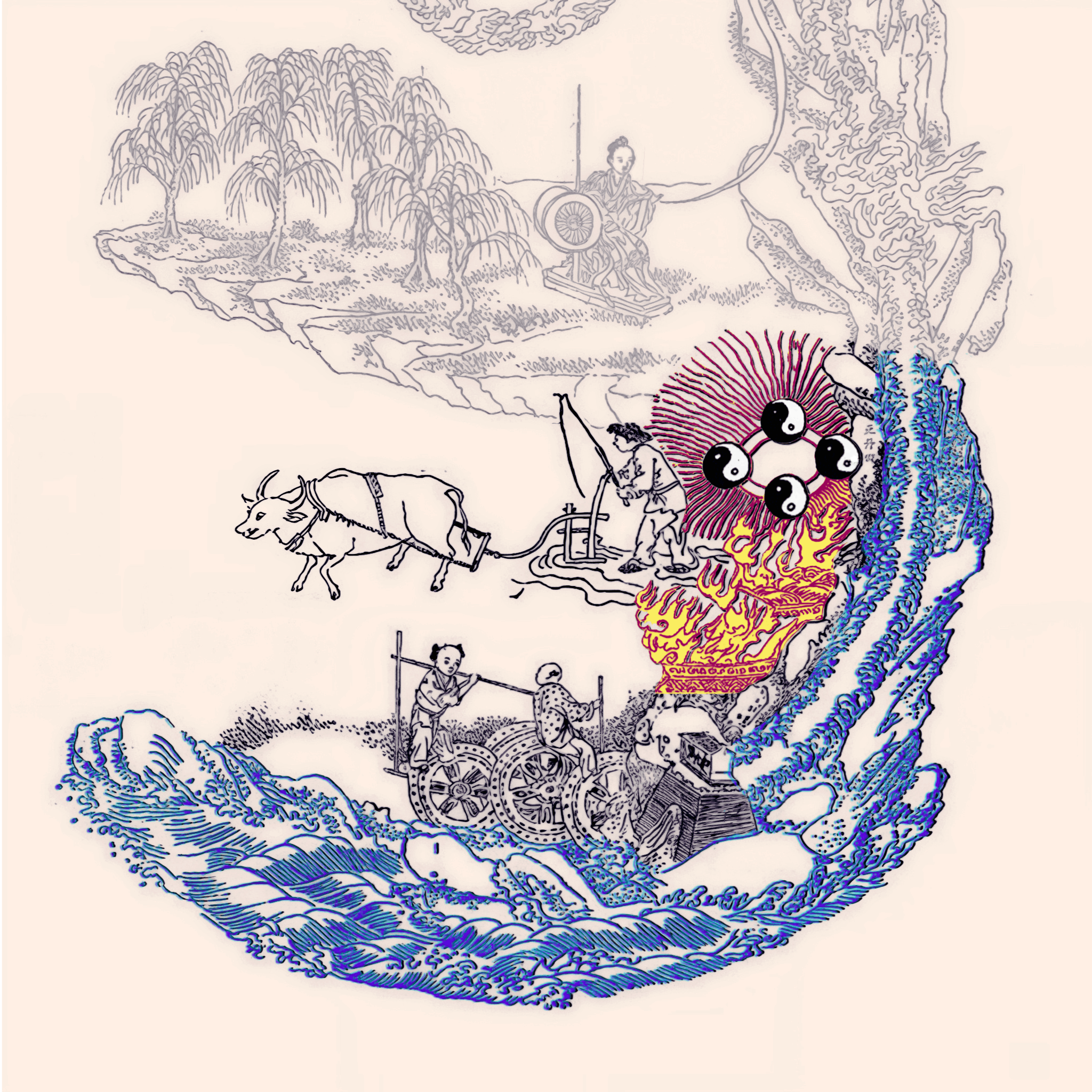
the three centres and the Taiji Pole
S.Pucelle -
According to ancient Taoist energy anatomy and physiology, human beings have three major energy centres, each of which stores and radiates energy in a manner analogous to a living battery.
These three centres are called the three Dantians.
The three Dantians are located along the Taiji pole (Tàijí Gān 太极杆) on thefontanelle–perineum axis, acting as the main conduit for Qi (vital energy). The Dantians, or “elixir fields,” are reservoirs used to cultivate Jing (essence), Qi (substance/energy), and Shen (spirit) in the internal arts.
The lower dantian (下丹田, Xià, abdomen) is located in the lower abdomen and is associated with grounding and physical vitality.
The middle dantian (中丹田, Zhōng, heart/chest) governs emotions and the circulation of Qi, located at the level of the heart.
The upper dantian (上丹田, Shàng, forehead/third eye) refines the mind and consciousness, located at the forehead, between the eyebrows.

In classical Chinese thought, Taiji denotes the fundamental principle or axis of the universe, comparable to a central beam supporting the world's structure. From this axis arise the two complementary aspects of yin-yang, whose alternations give rise to all phenomena. The lower Dantian is sometimes called the lower gate of the Taiji Pole.
This axis correlates with key meridians such as:
The Conception Vessel (Ren Mai - front midline)
The Governor Vessel (Du Mai - posterior midline)
The Penetrating Vessel (Chong Mai - Central Channel)
These form an energetic pillar similar to the yogic Sushumna or the chakra column.
This alignment encompasses both the physical structure—including the spine and the central nervous system—and the subtle energy fields. Taiji Pole organises the distribution of energy by receiving Qi from the earth (the telluric field) below and the heavens (the magnetic field) above, while regulating physiological rhythms such as breathing, heart rate, and craniosacral flow. This connection enhances balance, vitality, and internal energy, thereby preventing blockages that can lead to physical or emotional imbalance.
In the internal arts, the cultivation of Qi follows this sequence: refining the Jing (essence) in the lower dantian to produce Qi (substance/energy), then Qi to the Shen (spirit) in the upper centers.
Lower Dantian - Xia Dantian (下丹田)
The lower abdominal area (below the navel), known as the Lower Dantian, acts as the body’s energetic root and serves as the source from which this process—as the center of gravity and reservoir of prenatal Qi—nourishes the Middle (Heart) and Upper (Mind) Dantians.

In Chapter 3 of the Daode Jing, Laozi states that the wise person “empties their heart/mind and fills their belly (lower dantian).” —— “emptying the heart/mind” (xū qí xīn) means to silence the mental chatter, while “filling the belly” (shí qí fù, abdomen) refers to storing Qi in the lower dantian.
It is from this region of the body that all the power driving it originates. This space represents the center of gravity; it is surrounded by various muscle groups and connective tissues. This complex network of tissues is connected to most of the body’s myofascial lines. The more the neural pathways establishing this connection develop, the more the relationship with this space manifests. Thus, by developing and refining mental qualities such as clear, stable, and relaxed attention, one naturally acquires a balanced and functional energy system, resulting from a calm and structured mind. At the same time, the development of energetic qualities reinforces mental qualities.
It is the quality of the Yi (gentle, focused attention of the mind) that guides and organizes internal processes, including Qi, structure, movement, and perception. Practitioners of internal arts, or “cultivators, ” feel a distinct warmth in the lower abdomen, pulsations, or a sensation of fullness.
In these teachings, the expression Yi dao - Qi dao (意到, 氣到) refers to the close relationship between Qi and refined, focused attention. This concept is generally translated as “where the mind goes, energy follows.” In internal practices, it is believed that focused, gentle, and continuous Yi naturally reorganizes the field of Qi. This principle guides the coordination of attention, mind, and Qi, allowing the practice to remain subtle and internal, so that energy flows from a relaxed and grounded awareness rather than from physical or mechanical effort.
Through a steady inner awareness, the Qi, the body, and the mind gradually regain their balance.
Location of the Lower Dantian
There are no ancient Taoist texts that explicitly describe the lower dantian as having a specific geometric shape, such as a triangle, a cauldron, or a sphere.
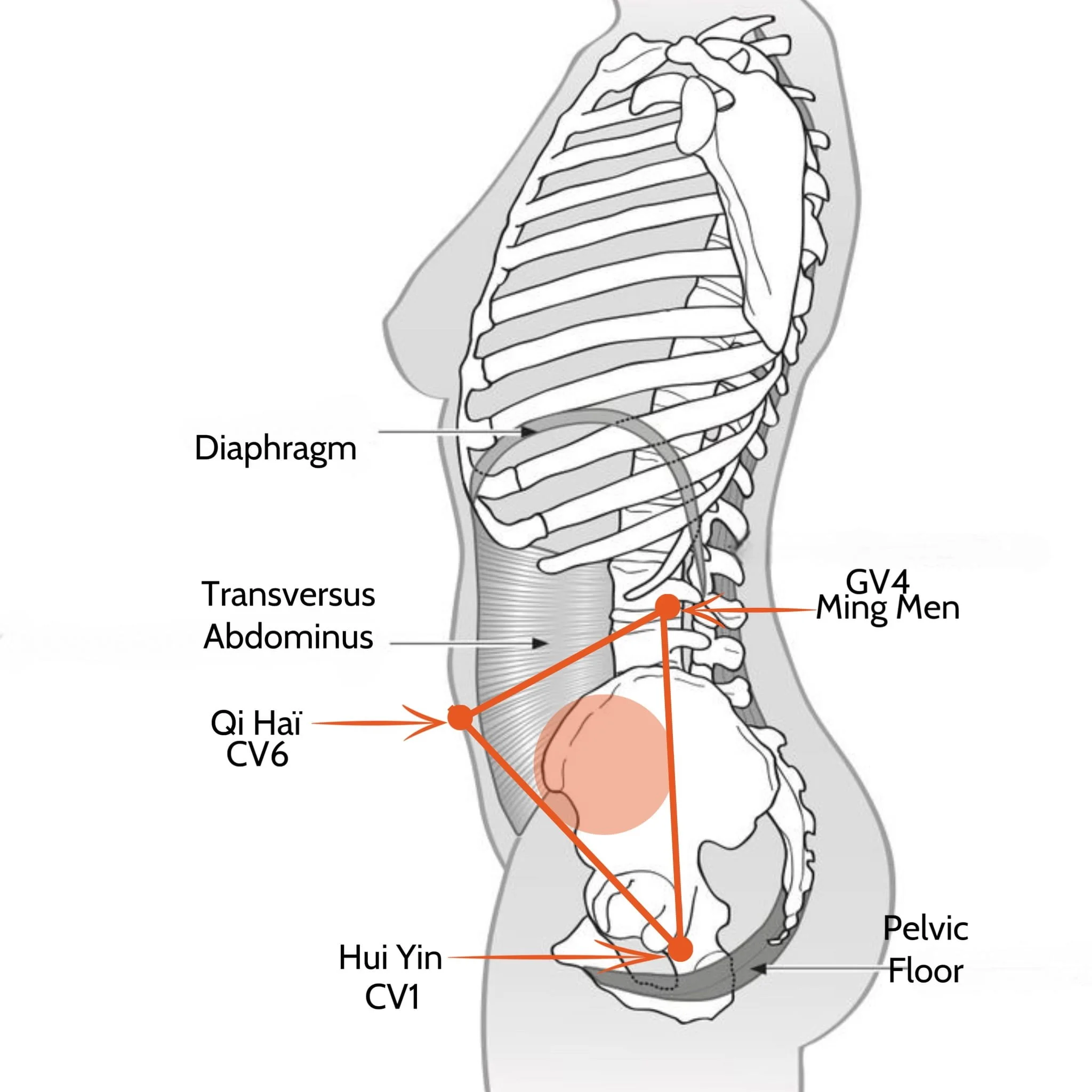
The symbolism of the triangle appears later in the Taoist traditions of Qigong and Neidan internal alchemy, where it often represents its anatomical boundaries in the lower abdomen, between the navel region, the two iliac crests of the hips, and the perineum. This triangular image emphasizes that the lower abdomen and pelvis act as a cauldron or crucible that collects and retains Qi.
This inverted triangle visually directs awareness downward, toward the perineum and the legs, thereby reinforcing the sense that energy should sink, ground, and stabilize in the lower body rather than disperse upward. This geometric shape results from the connection of three key points:
Qi Hai 气海 (Sea of Qi) - 2 finger-widths below the navel.
Mingmen Mingmen (Gate of Life) - between the 2nd and 3rd lumbar vertebrae, centered on the spine between the kidneys.
Hui Yin 会阴 (union of Yin) - perineum
It is important to note that, like its upper counterparts, the lower Dantian is not a single point, but an extensive area.
The Field and The Elixir
Activating the lower dantian is a two-step process:
The first step involves consolidating and structuring “the field” 田 (tián), which is regarded as the receptacle of essence and spirit. This is achieved through a combination of breathing techniques, manipulation of magnetic and energy fields within the body using specific hand positions, and meditative exercises, until the field reorganizes itself. This new configuration allows for the accumulation of Qi.
Once enough Qi has been gathered, it is then linked to the breath through the practice of reverse breathing. During inhalation, the abdomen is drawn inward, and the perineum (Huiyin) is lifted; upon exhalation, the abdomen expands, and the perineum is gently released. This process energises the Dantian by merging Qi with the breath, which triggers its movement and circulation.
丹 (dān): means “cinnabar” or “vermilion,” a red mercury sulfide (HgS) used in alchemy (Waidan, or external alchemy) to produce“elixirs of immortality.” Metaphorically, it represents the refined essence (jing) transformed into vital energy (Qi), which corresponds to the process of refinement practiced in Neidan, or internal alchemy.
Breathing exercises draw the diffuse Qi toward the lower abdomen, establishing a connection with the abdomen in all directions (front, back, sides, and the pelvic floor). As a result, Qi accumulates naturally without conscious effort.
The Lower Dantian is considered present and active from childhood and does not need to be created ex nihilo in adulthood. It is described as a distinct and identifiable function occupying the space between the diaphragm and the pelvic floor, as well as between the abdominal wall and the lumbar region. Its activity wanes during puberty, then gradually declines in adulthood due to natural degeneration, hygiene, and lifestyle factors.
At this point, it becomes the Lower Jiao (下焦, Xià Jiāo), also known as the “lower burner” or “lower heater,” a key concept in traditional Chinese medicine (TCM) referring to the lowest of the three divisions of the jiao (San Jiao) of the torso. It extends over the area below the navel, housing the kidneys, liver, bladder, intestines, and reproductive organs.
In the internal arts, the lower dantian refers to the source of Qi—that is, the area from which it emanates, to which it returns, where it accumulates, and where it transforms. Its activation or re-consolidation restores its original density, which relies on cultivation through breath, stillness, and applied attention characteristic of the internal arts. This process of involution is often called "the return to the source."
Join us for an online session and discover one of our courses on activating the lower Dantian.